
Assessment Guidelines for Digital Information Forensics (IMR543) Semester March – August 2025
Published: 31 May, 2025
| Category | Assignment | Subject | Education |
|---|---|---|---|
| University | University Teknologi MARA (UiTM) | Module Title | IMR543: Digital Information Forensics |
IMR543 Final Test/ Final Assessment (30%) – Week 13/ Week 14
CLO1: Describe the characteristics of electronic evidence that complies with legal requirements (C2). Students are required to explain their answers in the final test (2 hours).
The final test consist of:
- Part A: True/False
- Part B: Short answers
- Part C: Case study
IMR543 Group Assignment (60%)
CLO2: Display the forensic Evidence Investigation processes, methodologies and steps in conducting a forensic investigation. (P4)
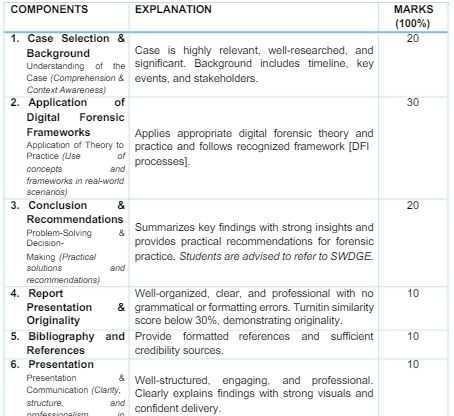
1. Case Study Analysis Details (40%) – Submission: Week 12 & Week 13
A case study analysis in a digital information forensics course allows students to explore real- world scenarios by applying theoretical knowledge to practical situations. Students are required to identify a real digital information forensics case and displayan analysis based on the guidelines given
Below are the key components and structure for conducting a thorough case study analysis.
Achieve Higher Grades IMR543 Assignment
Order Non Plagiarized Assignment
IMR543 Individual Assignment (10%) – Submission: Week 4
CLO3: Explainrelationship between Forensic Evidence Investigation and Records Management. (A4)
1. Scientific Working Group on Digital Evidence (SWGDE): Article Summary (10%)
Students are required to present and explain ONE (1) best practice/guideline prepared by Scientific Working Group on Digital Evidence (SWGDE) from SWGDE during knowledge sharing session.